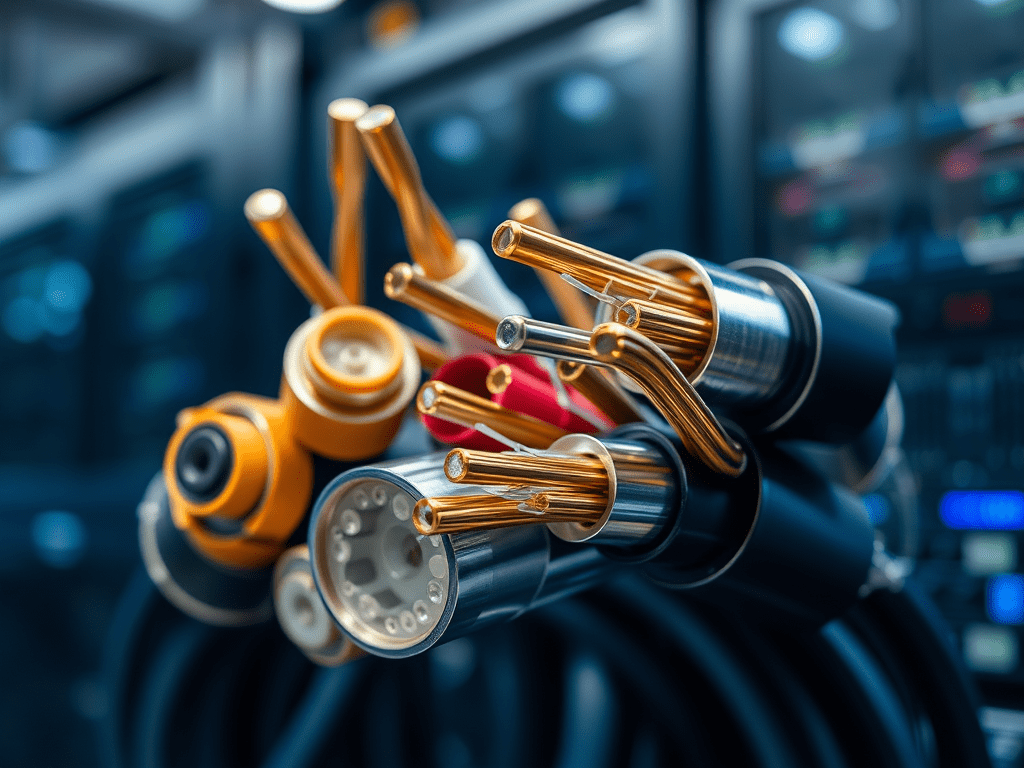
Coaxial Cable: From Early RF Pioneers to Today’s Multi-Gig Networks — And Why Conversions Tech Coax Leads on Performance, Consistency, and Total Cost
Summary (for skim readers):
Coaxial cable (“coax”) is still the backbone for broadcast, CATV, DOCSIS cable-modem service, satellite, SDI video, RF test/measurement, and increasingly mixed-signal infrastructure in smart buildings, marine/RV, and campus environments. Its enduring value comes from controlled impedance, excellent shielding/EMI immunity, predictable attenuation across decades of frequency spectrum, and simple, field-proven termination. This guide walks through how coax works, what matters technically, where it’s used now, and how to choose the right construction. We then detail why many integrators, cable/internet providers, RV builders, and residential contractors standardize on Conversions Tech coax for day-to-day reliability, repeatable specs, and supply stability.
Quick links:
- Browse all coax → conversionstech.com/search?q=coax
- RG6 (CATV/DOCSIS/sat) → conversionstech.com/search?q=rg6
- RG11 (long runs/low loss) → conversionstech.com/search?q=rg11
- Quad-shield RG6 (high EMI) → conversionstech.com/search?q=rg6+quad
- Compression F/BNC connectors → conversionstech.com/search?q=coax%20compression%20connector
- Splitters/taps/amps → conversionstech.com/search?q=coax%20splitter
- Tools & prep → conversionstech.com/search?q=coax%20tool
1) A Brief History: Why Coax Was—and Still Is—the RF Workhorse
Coax emerged in the early 20th century as radio and telephony demanded low-loss, interference-resistant transmission lines. The concentric geometry—center conductor, dielectric, shield, jacket—created a uniform electromagnetic field confining energy between conductor and shield. Compared to open-wire or twisted pairs, coax gave designers controlled impedance and predictable attenuation over a wide band. By mid-century, it was standard in broadcast, radar, and lab instrumentation. In the 70s–90s, CATV and satellite scaled coax to the last mile and into homes. Even with fiber everywhere today, coax remains the dominant HF/VHF/UHF to microwave copper medium for:
- DOCSIS cable modems and set-tops
- Satellite L-band/IF distribution
- RF distribution in DAS/SMATV/MATV
- SDI video (3G/6G/12G) in production and venues
- Antennas, instrumentation, test leads, and more
Coax stays relevant because it balances cost, simplicity, EMI immunity, and bandwidth. And in buildings/RVs/marine, you can pull and terminate it quickly without fusion splicers, making expansions and service calls far faster.
2) How Coax Works (The Field View): TEM Mode, Impedance, Shielding, and Loss
TEM propagation. Coax carries a transverse electromagnetic (TEM) mode: electric and magnetic fields are confined within the dielectric between center conductor and shield. That confinement is what gives coax its famous EMI immunity and low radiation.
Impedance (Ω). Most broadband RF/video infrastructure uses 75 Ω (RG6/RG11/RG59) because it minimizes attenuation for voltage-mode signals; test/measurement and RF power often use 50 Ω (RG58, RG8, LMR-type) trading slightly higher attenuation for power handling. Staying matched (75↔75, 50↔50) reduces reflections (return loss/VSWR) and protects SNR.
Shielding effectiveness (SE). Foil + braid (or quad-shield) provides transfer impedance low enough to reject ingress/egress. The spec lives in dB of isolation across frequency; higher is better. Construction details—foil type (bonded/non-bonded), braid coverage %, pick angle, copper type/plating—determine real performance.
Attenuation (dB/100 m). Loss increases with frequency via conductor skin effect and dielectric loss. Larger diameter (e.g., RG11) means lower loss than RG6 at the same frequency/distance. The dielectric (solid vs gas-injected/foamed) and conductor (solid copper vs copper-clad steel) matter, too.
Velocity of propagation (VoP). A function of dielectric, VoP impacts timing and SDI limits. Gas-injected foams raise VoP, reducing dispersion.
Mechanical & environmental. Jackets (PVC/PE/LSZH), messengered aerial options, UV stabilizer packages, cold-bend/cold-impact performance, and direct-burial waterproofing are what keep installations alive for decades—not just the sweep chart.
If you want a deeper dive, our engineers can share lab plots for typical Conversions Tech constructions; contact us from any product page or through support.
3) Today’s Use Cases (and Which Cable Fits)
3.1 DOCSIS (1.1 → 3.1/4.0) & CATV
DOCSIS pushes spectral use from 5–1218 MHz (and beyond), with OFDM and tight upstream noise budgets. This is why modern drops demand low attenuation, excellent return loss, and high SE to stop ingress from ham radios, LTE, 5G, and domestic noise sources.
- Choose RG6 for typical residential drops:
RG6 options - Choose RG11 for long runs, long driveways, MDUs:
RG11 low-loss - In harsh EMI, use quad-shield RG6 QS:
RG6 quad-shield - Pair with compression F connectors for sealed, consistent terminations:
F compression
3.2 Satellite IF/L-Band & SMATV/MATV
Satellite IF runs ~950–2150 MHz (and higher for multiswitches). Attenuation and return loss define picture quality and tuner lock times; shielding blocks LTE/5G ingress.
- RG6 QS for home distribution; RG11 for trunking main risers:
RG6 QS • RG11 - Compression F and weather boots outdoors:
Coax weather accessories
3.3 Professional Video (SDI 3G/6G/12G)
12G-SDI pushes ~12 Gbit/s over 75 Ω coax. The gating specs are return loss and attenuation at ~3–6 GHz harmonics. Cable geometry and dielectric purity must be tight to prevent eye diagram collapse.
- Ask us for 12G-rated 75 Ω constructions and matched BNC compression:
75 Ω BNC connectors
3.4 RF/DAS/Test & Instrumentation
Where 50 Ω rules (TLAs, analyzers, two-way radio feed lines), look for solid copper or silver-plated center conductors and robust braids/foil. We can supply 50 Ω builds on request.
- Start a spec conversation: Contact
3.5 Smart Buildings, RV/Marine, and Campus
Coax still does CATV, sat, RF sensors, SDI, IF, and legacy video in multi-dwelling/MDUs, hotels, stadiums, and smart homes. In RVs and marine, vibration, UV, and temperature cycling demand UV/abrasion-resistant jackets and robust compression terminations.
- RV/Marine-ready RG6 & accessories:
RG6 • Compression tools
4) Choosing Construction: The Variables That Actually Matter
Center conductor
- Copper-clad steel (CCS) for CATV/DOCSIS: better pull strength, excellent at HF/UHF due to skin effect using copper cladding.
- Solid copper where DC continuity matters (LNB power, active devices through cable) or for certain SDI/radio applications.
Dielectric
- Gas-injected (foamed) PE, sometimes skin-foam-skin: lowers dielectric constant → lower loss and higher VoP. Watch for consistency; poor foaming raises return loss.
Shield
- 100% bonded aluminum foil + 60–90% copper braid is the modern baseline; quad-shield adds a second foil and additional braid for hostile EMI environments. Braid coverage %, wire diameter, and pick angle affect real SE.
Jacket
- PVC (CM/CMR) for indoor/riser;
- PE (UV/direct-burial) for outdoors;
- Low-Smoke Zero-Halogen (LSZH) for certain code environments.
Flame rating
- CM/CMR/CMP (plenum) per NEC;
- Direct-burial water blocking compounds where trenching.
Messengering & Armor
- 1/4″ EHS messenger for aerial drops;
- Armored for rodent/rock protection.
Check our catalog queries and spec pages:
5) The Measurables: What You Should Ask For—and Why We Obsess Over Them
Return Loss (RL). At DOCSIS bands and SDI harmonics, RL tells you how well the line is matched. Higher (in dB) is better. Controlling impedance tolerance (e.g., 75 Ω ±1.5 Ω) across temperature and bend radii is a manufacturing art—dielectric uniformity, tooling, and feedback control are critical.
Shielding Effectiveness (SE). Real-world ingress (LTE/5G, two-way radio) and egress (FCC leakage) demand high SE across hundreds of MHz. That’s more than braid %; it’s foil quality, bond integrity, braid wire diameter, and pick angle stability.
Attenuation. We publish typical dB/100 m at multiple spot frequencies and guarantee sweep performance across the band. Larger OD (RG11) will outperform RG6 over distance; don’t torture RG6 beyond design lengths.
Environmental robustness. Cold bend/impact, UV exposure, jacket abrasion, and water blocking move the needle on service calls. Ask for UV test hours, cold-bend temp, and jacket hardness if your runs live outdoors.
You can request current lot data from any Conversions Tech product page:
- Start with coax search → open the SKU → use Contact.
6) Terminations, Tools, and Practices (for Low Troubleshooting)
- Use matched compression connectors (F or BNC) designed for the exact cable OD and jacket.
Browse: F/BNC compression - Prep cleanly: uniform strip lengths, no foil tearing, braid neatly folded; no stray strands touching center pin.
- Seal outdoors: weather boot or mastic + tape; direct-burial needs water block + proper enclosures.
- Avoid tight bends right at the connector; respect minimum bend radius.
- For splitters/amps, use quality parts with return-path specs: splitters/taps/amps
7) Why Many Builders, ISPs, MSOs, RV/Marine OEMs, and Contractors Prefer Conversions Tech Coax
This is where the engineering meets the jobsite. Our coax program is built around three pillars: measured performance, manufacturing repeatability, and installer-centric details.
7.1 Tight Electrical Control (Where It Counts)
- Impedance control: We target 75 Ω ±1.5 Ω on RG6/RG11 families, because better match → better return loss → cleaner modem SNR and longer SDI limits.
- Dielectric consistency: Gas-injected foam with statistically controlled cell size and concentricity for predictable attenuation and VoP.
- Shield stack: Bonded foil + high-coverage braid (and quad-shield options) with controlled pick angles to hold shielding effectiveness across bends and temperature.
Explore: RG6 series • RG11 series • Quad-shield
7.2 Real-World Robustness
- UV stabilization in outdoor jackets; cold-bend and cold-impact performance so winter service doesn’t crack jackets.
- Direct-burial options with water-block compounds and wet-rating.
- REELEX or installer-friendly payout packaging to reduce kinks and snarls.
7.3 Compatibility and Ecosystem
- Our compression connectors are matched to OD/trim schedules for repeatable crimps and lab-grade RL at the interface.
- Stocked accessories—splitters, taps, amps, weather boots—keep your truck rolling with a single vendor.
Shop: connectors • splitters/taps • tools
7.4 QA and Traceability
- 100% sweep-tested lots, traceable by reel ID.
- Process controls on braid pick, foam density, OD/ovality, and adhesion so the 500th reel behaves like the 1st.
7.5 Lead Time, Price Stability, and Support
- Installers care about availability and consistency. Our stocking strategy and forecasting keep common SKUs ready to ship, with competitive pricing backed by RF performance.
- Support that actually answers: spec clarifications, connector cross-references, lot data—available from the product page or contact.
Note on comparisons. We respect other brands in the market. Performance depends on the specific SKU and lot across any manufacturer. Our goal—and what our customers tell us— is that Conversions Tech strikes a better balance of spec performance, consistency, and cost for the day-to-day builds they run.
8) Application-Specific Playbooks
8.1 Cable/Internet Providers (DOCSIS)
Problem: Upstream ingress and return-path noise are expensive.
Fix with Conversions Tech:
- Specify quad-shield RG6 for noisy neighborhoods or apartments.
→ RG6 QS - Use compression F only; ban hex crimp.
→ Compression F - For long drops, move to RG11; protect SNR margins.
→ RG11 trunk
8.2 Satellite/SMATV Integrators
- Keep RL high with tight-tolerance RG6/RG11; use sealed connectors outdoors.
- For multiswitch hotels/MDUs, plan risers with RG11 and split to RG6 per floor.
→ RG11 • RG6
8.3 RV Manufacturers
- Use UV-stable RG6 and compression connectors; vibration-resistant seating.
- Route away from engine heat; secure every 18–24″.
→ RG6 outdoor • Tools
8.4 Residential/Custom Install
- Prewire 2× RG6 to each TV location; one spare saves truck rolls.
- For smart homes: add a central coax panel with labeled splitters.
→ Splitters/taps
8.5 Venues/Production (SDI)
- Specify 12G-capable 75 Ω coax and precision BNC; verify lengths vs eye diagram budgets.
→ Ask us for 12G builds • BNC connectors
9) Frequently Asked Technical Questions (FAQ)
Q1: RG6 vs RG11—when to choose which?
RG11 has a larger OD and lower attenuation; use it for long runs, trunk lines, or marginal SNR links. RG6 is preferred for standard drops and easier routing.
Browse: RG6 • RG11
Q2: Is quad-shield always better?
Quad-shield improves shielding effectiveness in hostile EMI, but it’s stiffer and connectors must match OD. Use it where ingress is a problem (MDUs, near transmitters).
See: RG6 quad-shield
Q3: Copper-clad steel vs solid copper center conductor?
CCS is perfect for high-frequency RF—skin effect rides the copper, and CCS resists stretch/pulls. Solid copper is needed where DC power must flow (some LNB feeds, specialty apps) or for certain SDI preferences.
Q4: Why are compression connectors preferred?
Compression creates a 360° mechanical and RF seal, improving return loss and moisture resistance vs old crimp styles.
Shop: Compression connectors
Q5: Can I direct-bury RG6?
Only if it’s rated and water blocked. Otherwise use conduit. We offer outdoor/direct-burial options—ask via product pages.
10) Putting It Together: A Spec You Can Hand to Purchasing
- Coax: 75 Ω RG6 (quad-shield where needed) or RG11 as distance dictates; gas-injected dielectric; bonded foil + high-coverage braid; UV-rated jacket for outdoor; flame rating per code (CMR/CMP).
→ RG6 • RG11 • QS - Connectors: Matching compression F or 75 Ω BNC, weather boots outdoors.
→ F/BNC compression - Passives: Splitters/taps/amps with return-path specs.
→ Passives - Tools: Matched strip/compression tools; test kit for RL/ingress checks.
→ Tools - Vendor: Conversions Tech—lot-traceable, sweep-tested reels, consistent ODs for connector fit, fast ship.
→ All coax • Contact/quotes
11) Why This Often Beats “Big-Brand by Default”
Specifying a logo isn’t the same as specifying repeatable performance on the job. Large brands carry excellent products—but availability, lot-to-lot variance, pricing, and construction drift can still create field headaches. Many of our customers—MSOs, contractors, RV builders—tell us they switched to Conversions Tech because:
- They needed consistent OD and jacket hardness so compression connectors seat the same every time.
- They wanted predictable return loss at modern DOCSIS/sat bands without cherry-picking reels.
- They needed stock now, not in six weeks, at a price that didn’t blow the build.
- They wanted responsive support that could provide lot data, connector cross-references, and alternates quickly.
We’ll happily map your current spec to our SKUs and provide test data: start here → conversionstech.com/search?q=coax or Request a quote → Contact.
12) CTA: Build More Reliable RF With Conversions Tech Coax
- Shop RG6: conversionstech.com/search?q=rg6
- Shop RG11: conversionstech.com/search?q=rg11
- Shop Quad-shield: conversionstech.com/search?q=rg6+quad
- Compression connectors: conversionstech.com/search?q=coax+compression+connector
- Splitters & taps: conversionstech.com/search?q=coax+splitter
- Tools: conversionstech.com/search?q=coax+tool
- Project/volume quotes: conversionstech.com/pages/contact
 Conversions Tech
Leave a comment